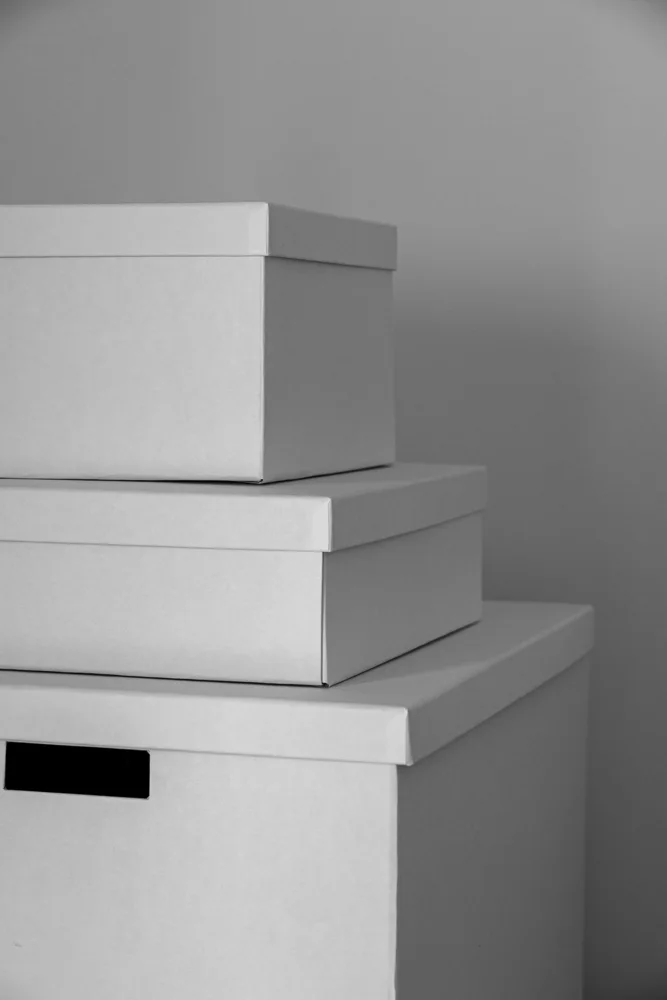
Stackable boxes can organize a shelf, but a tall stack may make its bottom container inconvenient to open. The right system depends on the objects, their weight, and how often they are retrieved. Start with the shelf's usable dimensions and the groups you want to store. Then compare boxes with lids fitted, their permitted stacking arrangement, and the room needed to lift them. A modest collection of accessible containers can be more useful than filling every available centimetre with a tightly packed stack.
Measure shelf access and closed boxes
Use the box's outside dimensions with the lid and any clips included. Compare them with the shelf width, depth, and front opening, including hinges or doors nearby. A box can fit the shelf cavity but be difficult to remove through a narrower opening. Leave room for fingers around the handle or rim and for the lifting motion. Tapered sides can reduce internal capacity, so compare the objects with usable interior dimensions separately from the exterior footprint that determines shelf fit.
Choose group sizes by retrieval
Small containers can separate categories but multiply lids and labels. Large containers reduce the number of pieces while making mixed contents harder to search. Group belongings around how they are used: a single project, a season, or a household task. Place the things you reach for most often where they can be removed without dismantling several other boxes. A transparent box can help identify contents, but a clear label on the accessible face remains useful when the front is crowded or the contents look similar.
Check the permitted stack
Read whether the lid creates the intended stacking surface and any limits on configuration or load. IKEA's SAMLA descriptions, for example, specify the role of the fitted lid in making the box stackable. That does not imply unlimited stacking or establish the shelf's own load capacity. Check both the containers and supporting furniture. Avoid mixing similar-looking boxes unless the maker explicitly supports that arrangement. Heavy contents and a tall stack require a different practical plan from several light textile boxes.
Make changes and cleaning manageable
Consider whether empty boxes nest and where spare lids will be kept. A standardized footprint can make later rearrangement simpler, but verify current compatibility rather than assuming every size in a named range shares one lid. Follow material care and storage-condition guidance for both box and contents. Do not infer waterproofing or suitability for every environment from a snap closure. Start with a few containers and assess the retrieval routine before ordering enough to fill the entire shelving unit.
THE USEFUL TAKEAWAY
Choose stackable boxes for accessible groups of belongings, not maximum packing density. Compare exterior fit, interior capacity, and the permitted stack separately. Leave room to lift each box, verify the supporting shelf, and begin with a small compatible collection before committing the whole storage area to one system.
Further information
Manufacturer and official references for the details discussed. Check instructions for the exact product you are considering.