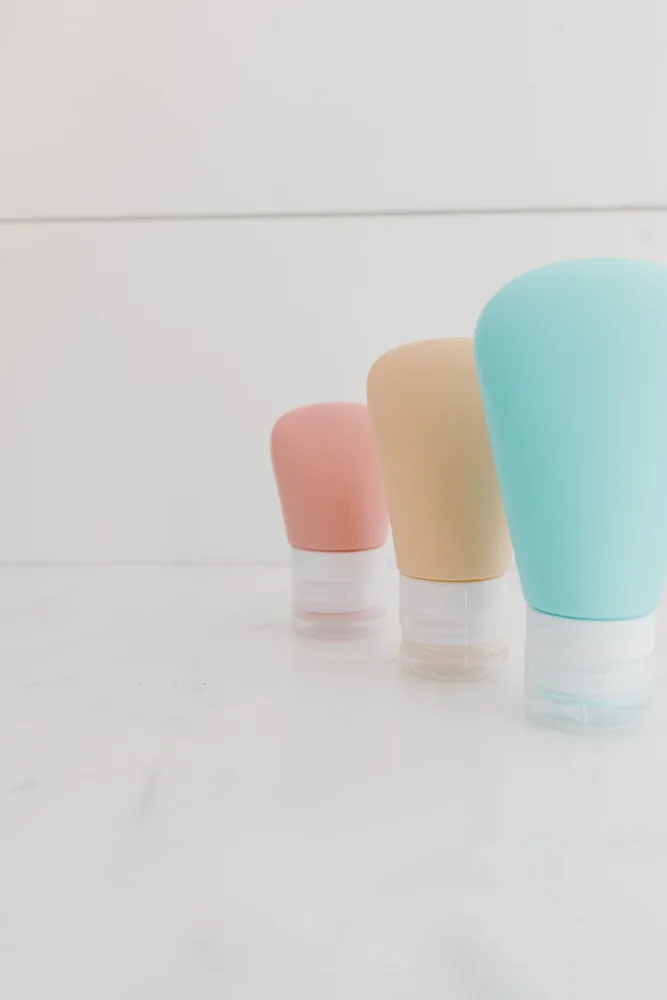
Travel bottles are useful when they carry the amount you need without adding uncertainty about leaks, material compatibility or airport rules. A coordinated set is less valuable if the dispensing caps do not suit your shampoo or the containers are difficult to clean. Begin with the products and trip length, then check the bottle maker's permitted contents and care instructions. Keep screening rules as a separate requirement. A small, clearly labeled set with practical closures can be more useful than many identical bottles filled without a plan.
Match the container to the contents
Read the travel bottle's material and the manufacturer's restrictions. Do not assume every cosmetic, alcohol-based liquid or oil suits every flexible container. The original product packaging may also contain storage or transfer guidance. Choose an opening wide enough for filling and cleaning, while checking whether the cap dispenses the product as intended. Thick creams and thin liquids can call for different closures. Keep the original labels or record essential product information so the decanted contents remain identifiable.
Check current screening requirements
For journeys through United States screening, TSA currently describes the carry-on liquids rule in terms of container limits and a single permitted bag. Read the current official guidance and its exceptions before travel. A partly filled oversized container is not automatically a suitable substitute for an allowed-size container. Other departure points or connecting airports may have their own rules. The travel bottle's marketing name is not evidence that every route will accept it, so check the actual authorities involved in your itinerary.
Choose closures you can inspect
Look at screw threads, seals, hinges and dispensing openings. A small removable seal can become easy to lose during cleaning, while a flip cap may need protection from being pressed inside the bag. Follow filling and closure instructions rather than overfilling to avoid carrying another bottle. Test the filled container in an appropriate contained setting before packing valuable belongings around it. A leak-resistant claim describes an intended design, not a guarantee under every pressure, orientation or product combination.
Plan labeling and cleanup
Use labels that remain legible during ordinary handling and identify similar-looking products clearly. Avoid putting incompatible contents into containers just to complete a matching set. Read the wash and drying method for every part, including caps and seals, and store bottles dry as instructed after the trip. A clear secondary pouch can make checking contents and containing minor spills easier, but choose it around current screening requirements and your actual luggage space rather than buying a large accessory kit by default.
THE USEFUL TAKEAWAY
Choose travel bottles around the specific product, closure and journey. Verify material suitability and current screening rules separately, then label and test the containers before packing. A few manageable bottles with a clear cleaning routine provide better value than a large matching set whose contents or limits are uncertain.
Further information
Manufacturer and official references for the details discussed. Check instructions for the exact product you are considering.