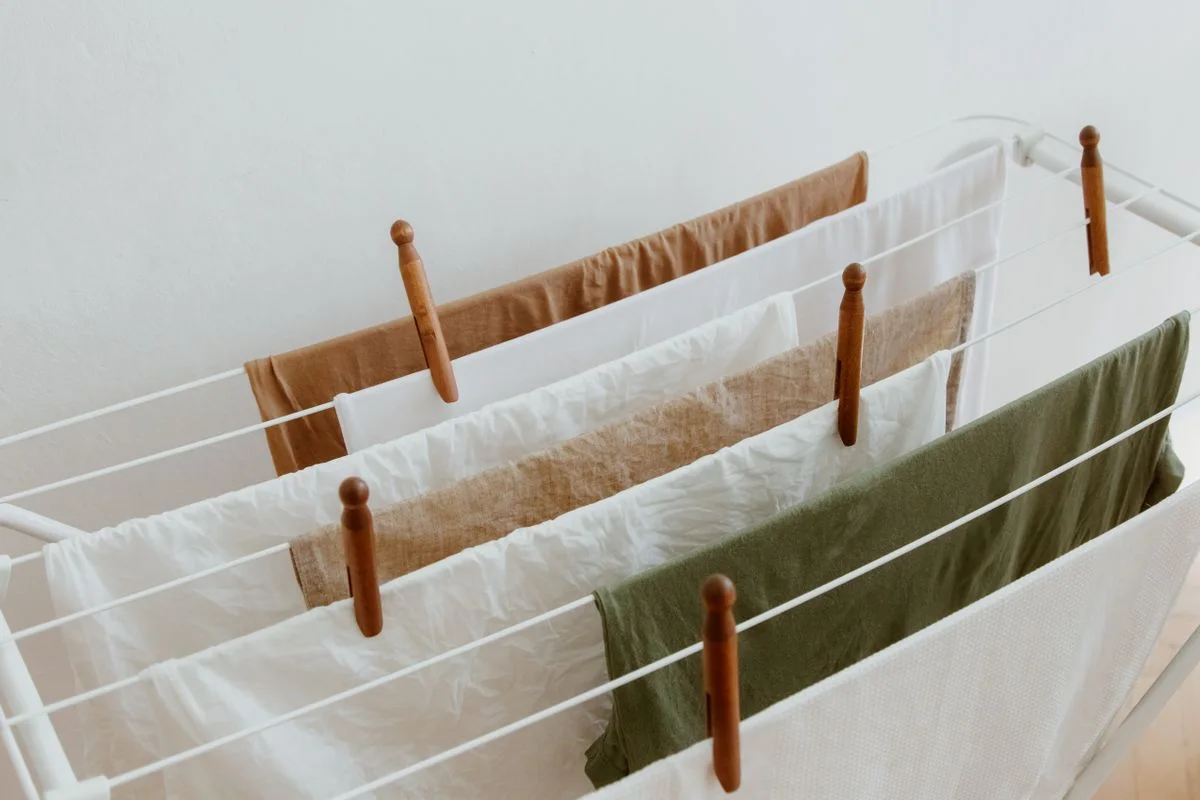
An apartment drying rack has to share space with everyday life. Its advertised line length is useful, but it does not tell you whether sleeves overlap, a long garment reaches the floor, or the open rack blocks the kitchen route. Begin with a normal wash and the place where it will dry. Compare the fully opened shape, garment clearance, and folded storage dimensions. A rack that suits one realistic load can be more convenient than a large design that must be rearranged constantly.
Compare rails with your normal laundry
Count the types of items in an ordinary wash: shirts, socks, trousers, towels, or delicate pieces. Rail spacing affects how they can be arranged, while the height above the floor affects longer items. A total drying length does not describe those relationships. Brabantia's product guides distinguish line space, flat-drying areas, and open dimensions, showing why each figure answers a different question. Choose around the garments you wash regularly rather than the largest theoretical number of small items a rack could hold.
Tape out the opened footprint
Measure the rack with wings, legs, and other extensions in their working positions. Mark that footprint on the floor and walk past it as you would during a normal evening. Leave access to doors, cupboards, and appliances. A tower may use less floor width but place rails at different heights, while a low winged rack spreads across the room. The useful format depends on your layout and reach, not just the folded photograph that appears first in a listing.
Check support and load guidance
Read the product's load limits and instructions for distributing laundry. A hanging rack also needs a support that meets its stated fit and use requirements; a door or rail should not be assumed suitable merely because a hook can reach it. Inspect locks and joints and follow the setup procedure. If delicate garments need flat drying according to their labels, confirm that the rack has an intended platform rather than improvising one from widely spaced rails.
Make folding and care practical
Find the folded height, width, and depth, then check the gap where you intend to store the rack. Include clips or protruding feet that may prevent it from sliding into a narrow space. The rack should be clean and stored as its instructions require. Garment care labels still determine permitted drying methods; GINETEX's guidance explains the role of those labels. A rack's capacity does not override an item's need for a particular drying position or treatment.
THE USEFUL TAKEAWAY
An apartment drying rack should fit the laundry and the room at the same time. Compare line arrangement, full open dimensions, and folded storage rather than capacity alone. Follow rack setup guidance and garment care labels, and choose a manageable everyday load over a design that repeatedly blocks your home.
Further information
Manufacturer and official references for the details discussed. Check instructions for the exact product you are considering.